

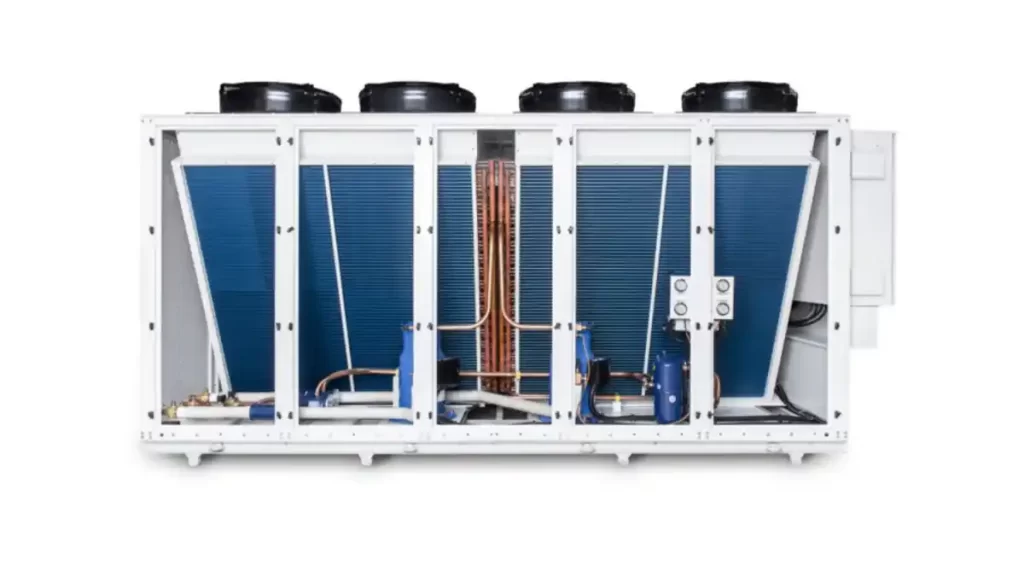
Condensing units are main complementary part of air conditioning systems.
Reliable operation and easy maintenance. Increase energy saving and lower energy cost of your buildings.
Technical Details
- High-efficiency scroll compressors
- Independent refrigeration circuits
- 8 kW - 500 kW Cooling Capacity
- R-410A, R-407C refrigerant
- Designed to operate in a wide range 5 °C - 56 °C
- Easy Maintenance
Request Form
What is a Condensing Unit?
A condensing unit is a key component in a refrigeration or air conditioning system, responsible for dissipating heat from the refrigerant. It works in conjunction with the evaporator and other system components to complete the refrigeration cycle, providing cooling for various applications. Condensing units are commonly used in commercial, industrial, and residential HVAC systems. Here’s a detailed look at the components, functions, applications, and benefits of condensing units.
Components of a Condensing Unit
A typical condensing unit includes several essential components:
- Compressor: Compresses the refrigerant, increasing its pressure and temperature.
- Condenser Coil: Allows the hot, pressurized refrigerant to release heat to the surrounding air, condensing it into a liquid.
- Fan: Helps to move air over the condenser coil, facilitating heat dissipation.
- Expansion Valve: Controls the flow of refrigerant into the evaporator, where it absorbs heat.
- Receiver/Drier: Stores excess refrigerant and removes moisture and contaminants from the system.
- Housing: Protects internal components and can be designed for outdoor installation.
Function of a Condensing Unit
The primary function of a condensing unit is to expel the heat absorbed by the refrigerant in the evaporator:
- Compression: The compressor compresses the refrigerant gas, raising its pressure and temperature.
- Heat Dissipation: The hot refrigerant gas passes through the condenser coil, where it releases heat to the surrounding air, aided by the fan.
- Condensation: As the refrigerant loses heat, it condenses into a high-pressure liquid.
- Expansion and Cooling: The high-pressure liquid refrigerant then flows through the expansion valve into the evaporator, where it expands, cools, and absorbs heat from the indoor air.
Applications of Condensing Units
Condensing units are used in various cooling and refrigeration applications, including:
- Residential Air Conditioning: Providing cooling for homes.
- Commercial HVAC Systems: Cooling spaces in offices, retail stores, and restaurants.
- Industrial Refrigeration: Used in warehouses, manufacturing facilities, and cold storage units.
- Refrigerated Transport: Ensuring temperature control in trucks and containers.
- Data Centers: Cooling servers and other IT equipment to prevent overheating.
Benefits of Condensing Units
- Efficient Heat Dissipation: Effectively removes heat from the refrigerant, ensuring efficient cooling.
- Versatility: Can be used in a wide range of cooling and refrigeration applications.
- Compact Design: Often designed to be compact and durable for outdoor installation.
- Energy Efficiency: Many modern units are designed to be energy-efficient, reducing operational costs.
- Reliability: Built to operate reliably in various environmental conditions, ensuring consistent performance.
Comparison with Evaporator Units
While condensing units expel heat from the refrigerant to the outside environment, evaporator units absorb heat from the indoor air to cool it. Both units are crucial in the refrigeration cycle but perform opposite functions: the evaporator cools the indoor space, and the condensing unit dissipates the absorbed heat outdoors.
In summary, a condensing unit is a critical component in HVAC and refrigeration systems, responsible for releasing heat from the refrigerant to provide effective cooling. Its efficient operation is essential for maintaining comfortable indoor temperatures and preserving perishable goods in various applications.
FAQ
Condensing units are a critical component of HVAC systems, responsible for releasing heat absorbed from indoor spaces. They compress refrigerant gas into a liquid, releasing heat through the condenser coil and expelling it outside. This process is essential for cooling and refrigeration applications.
The primary types of condensing units include air-cooled and water-cooled units. Air-cooled condensing units use ambient air to dissipate heat, while water-cooled units use water and are often employed in larger commercial and industrial applications.
Choosing the right condensing unit depends on factors such as the cooling capacity required, the type of refrigerant used, energy efficiency ratings, and the specific application (residential, commercial, or industrial). Consulting with an HVAC professional can help ensure the best selection.
Yes, condensing units can be part of heat pump systems that provide both heating and cooling. In heating mode, the refrigerant flow is reversed, allowing the unit to absorb heat from the outside air and transfer it indoors.
Regular maintenance for condensing units includes cleaning the condenser coils, checking refrigerant levels, inspecting and cleaning fans and fan motors, and ensuring all electrical connections are secure. Professional servicing at least once a year is recommended to keep the unit running efficiently.
Ambient temperature can significantly impact the efficiency of a condensing unit. Higher outdoor temperatures can reduce the unit’s ability to dissipate heat, leading to decreased efficiency and higher energy consumption. Conversely, cooler temperatures can enhance performance.
High-efficiency condensing units offer several benefits, including lower energy consumption, reduced operating costs, improved cooling performance, and a smaller environmental footprint due to lower greenhouse gas emissions.
Proper installation of condensing units is crucial for optimal performance. Key considerations include ensuring adequate airflow around the unit, proper placement to avoid obstructions, secure mounting to minimize vibrations, and correct refrigerant piping and electrical connections.
Condensing units play a vital role in the overall efficiency of an HVAC system by effectively managing the heat exchange process. Efficient condensing units reduce the workload on compressors, lower energy consumption, and improve the system’s ability to maintain desired indoor temperatures.
Recent advancements in condensing unit technology include the development of variable-speed compressors, enhanced heat exchanger designs, improved refrigerants with lower global warming potential (GWP), and smart control systems that optimize performance based on real-time conditions and energy usage.