

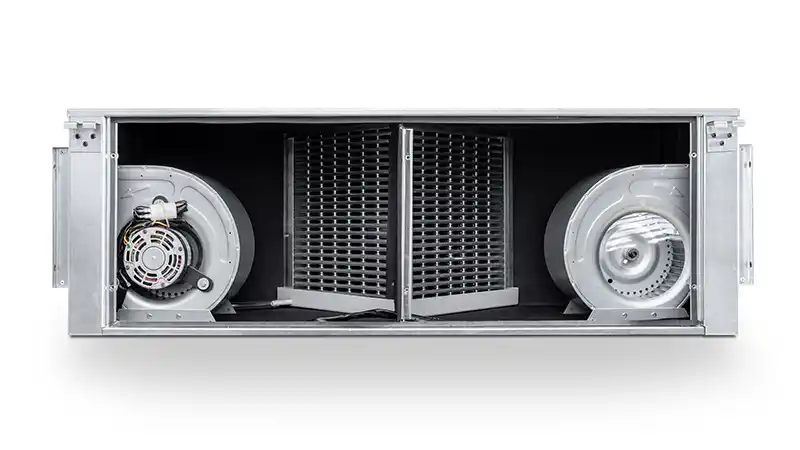
CLIMACS Heat Recovery Ventilation Units provide fresh air and improve indoor air quality with optional DX cooling and heating systems provide heating and cooling functions with lover cost.
Heat Recovery Ventilation Units ventilate rooms with most efficient ways by exchanging heat between exhaust air and supply air.
Request Form
Supply Fresh Air With High Energy Saving
Heat recovery ventilation unit provides fresh air with high energy saving by transferring the heat from exhaust air to the fresh air.
- Slim and compact design
- G4 Filter
- Heat and sound insulation with insulated internal surface.
- CE Marking, TSEK
- Low noise level
- Speed control
- Wide capacity range: 500 m3/h - 5000 m3/h
- Electronic control panel
- Easy installation and maintenance
Information About Heat Recovery Ventilator Unit (HRV)
Building Owners
Lower your energy cost while having an excellent indoor air quality. Decrease the loading on the main air conditioning unit with adding the heat recovery unit to increase efficiency while introducing fresh air from outside to inside of the system.
Design Office and Consultants
Manufacturing the essential components of Climacs Heat Recovery Unit ensures the flexible and custom design with high level of solution offering. Customers expectations and needs can be easily solved and supplied by our customizable production.
End Users
Increase your air indoor quality to have a pleasant living environment. Control the exact level of humidity in the air you breathe.Filter unwanted and harmful micro particles in the air. Remove odor and bad smell to enhance your living place air quality.
Installers
Since all the design of heat recovery unit is modular and contemporary, the installation and configuration time is reduced.
After Sales Service
Climacs has a wide range of distributors and services world-wide. No need to worry for component replacements, parts, services and maintenance since we are the core air conditioning unit manufacturer.
Wide Range of Uses
Wide range of usage areas such as; Residential, Office, Corporate, Financial Buildings, Chain Stores, Supermarkets, Shopping Malls, Sports Centers and Restaurants.
What is a Heat Recovery Ventilation (HRV) Unit?
A Heat Recovery Ventilation (HRV) unit is an HVAC system designed to improve indoor air quality and energy efficiency by exchanging stale indoor air with fresh outdoor air while recovering heat from the outgoing air. This process helps to maintain comfortable indoor temperatures and reduces the energy required for heating or cooling the incoming fresh air. Here’s an in-depth look at the components, functions, applications, and benefits of HRV units.
Components of a Heat Recovery Ventilation Unit
A typical HRV unit includes the following key components:
- Heat Exchanger: The core component where heat transfer occurs between the outgoing and incoming air streams without mixing them.
- Fans: Separate fans for exhaust and supply air streams to ensure proper airflow through the unit.
- Filters: Remove particulates and contaminants from both incoming and outgoing air.
- Dampers: Regulate and control the airflow through the unit.
- Sensors and Controls: Monitor and adjust the operation of the unit based on temperature, humidity, and air quality.
Function of an HRV Unit
The primary function of an HRV unit is to provide ventilation while recovering heat from the exhaust air:
- Exhaust Air Collection: Stale indoor air is collected and directed through the heat exchanger.
- Heat Transfer: The heat exchanger transfers thermal energy from the warm exhaust air to the incoming fresh air without mixing the two air streams.
- Fresh Air Supply: The pre-warmed (or pre-cooled) fresh air is supplied to the indoor environment, reducing the load on the heating or cooling system.
- Continuous Ventilation: Provides a continuous exchange of indoor and outdoor air, improving indoor air quality.
Applications of HRV Units
Commercial Air ConditioningHRV units are used in various residential, commercial, and industrial applications to enhance indoor air quality and energy efficiency:
- Residential Buildings: Homes and apartments to ensure a supply of fresh air and energy savings.
- Commercial Buildings: Offices, retail spaces, and restaurants to maintain a healthy indoor environment.
- Schools and Universities: Classrooms and lecture halls to provide fresh air for students and staff.
- Healthcare Facilities: Hospitals and clinics to ensure clean air and reduce energy costs.
- Industrial Facilities: Factories and warehouses to improve air quality and energy efficiency.
Benefits of HRV Units
- Improved Indoor Air Quality: Provides a constant supply of fresh air and removes stale air, reducing indoor pollutants.
- Energy Savings: Recovers heat from exhaust air, reducing the energy needed to heat or cool incoming fresh air.
- Enhanced Comfort: Maintains more consistent indoor temperatures and humidity levels.
- Environmental Benefits: Reduces greenhouse gas emissions by lowering energy consumption.
- Cost Efficiency: Decreases operational costs by reducing the load on heating and cooling systems.
Comparison with Energy Recovery Ventilation (ERV) Units
While both HRV and ERV units provide ventilation and recover energy from exhaust air, Energy Recovery Ventilation units also transfer moisture between the air streams. This makes ERV units more suitable for climates with high humidity, as they can help control indoor humidity levels more effectively than HRV units, which only transfer heat.
In summary, a Heat Recovery Ventilation (HRV) unit is a crucial component for improving indoor air quality and energy efficiency in various applications. By recovering heat from exhaust air and supplying pre-conditioned fresh air, HRV units help maintain comfortable indoor environments while reducing energy consumption and costs.
FAQ
An HRV unit works by using a heat exchanger to transfer heat from the outgoing stale air to the incoming fresh air. This process helps retain the heat inside the building during the winter and keep the cool air inside during the summer, enhancing overall energy efficiency.
The benefits of using an HRV unit include improved indoor air quality, enhanced energy efficiency, reduced heating and cooling costs, and a more comfortable indoor environment. It also helps to remove excess humidity and pollutants from indoor air.
HRV units are typically installed in residential, commercial, and industrial buildings where there is a need to improve indoor air quality and energy efficiency. They are often placed in mechanical rooms, attics, or basements, and connected to the building’s ductwork system.
HRV (Heat Recovery Ventilation) units primarily recover heat from the outgoing air to precondition the incoming air. ERV (Energy Recovery Ventilation) units, on the other hand, transfer both heat and moisture between the outgoing and incoming air streams. This makes ERVs more suitable for areas with high humidity levels.
Regular maintenance for HRV units includes cleaning or replacing air filters, inspecting and cleaning the heat exchanger, checking the operation of fans and motors, and ensuring that the intake and exhaust vents are clear of obstructions. It is recommended to perform maintenance at least twice a year.
HRV units are effective in a wide range of climates but are particularly beneficial in colder climates where heat recovery can significantly reduce heating costs. In very humid climates, ERV units may be more appropriate due to their ability to transfer moisture as well as heat.
An HRV unit improves energy efficiency by recovering heat from the exhaust air and transferring it to the incoming fresh air. This reduces the demand on the heating system in the winter and the cooling system in the summer, leading to lower energy consumption and cost savings.
Proper installation of HRV units involves ensuring adequate space for the unit and ductwork, correct placement of intake and exhaust vents, and proper sealing to prevent air leaks. Professional installation is recommended to ensure optimal performance and compliance with local building codes.
When choosing an HRV unit, consider factors such as the size and layout of the building, the climate, the unit’s efficiency rating, the type of heat exchanger, noise levels, and maintenance requirements. It’s also important to choose a unit that is appropriately sized for the ventilation needs of the space. Consulting with an HVAC professional can help ensure the best choice for your specific needs.
To ensure your HRV unit operates efficiently, follow these tips:
- Regular Maintenance: Clean or replace filters and inspect the heat exchanger regularly.
- Proper Installation: Ensure the unit and ductwork are installed correctly by a professional.
- Check Ventilation Paths: Keep intake and exhaust vents clear of obstructions.
- Balanced Ventilation: Make sure the HRV is properly balanced to avoid pressure imbalances in your home.
- Monitor Performance: Periodically check the system’s performance and address any issues promptly.